- Overview
- Know More
- Must See
- Photos/Video
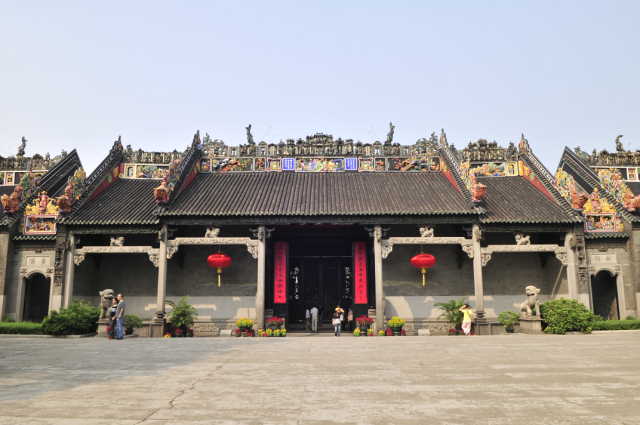
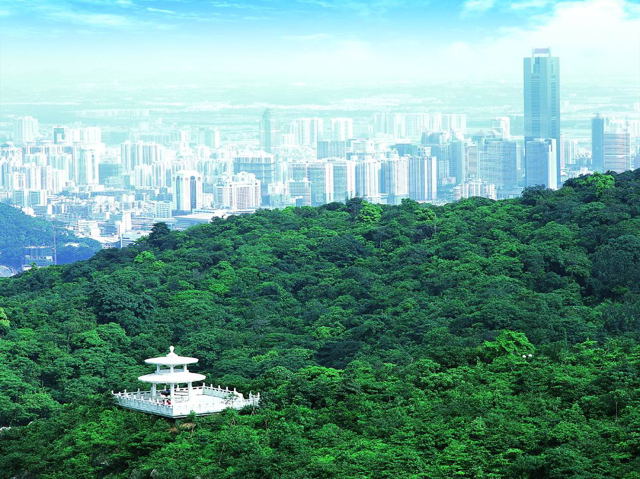
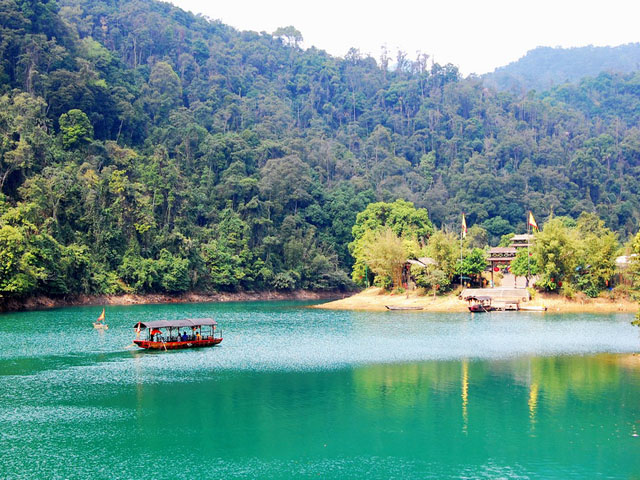
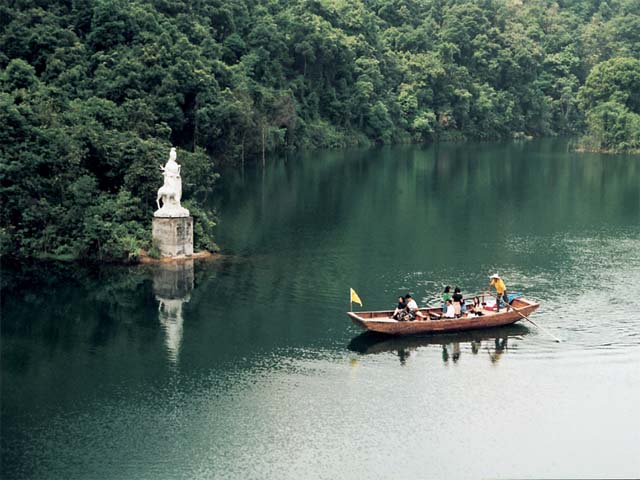
Dinghu Mountain is located in Dinghu District; 18km to the east of Zhaoqing City, in the Dayunwu Mountain Range, in Guangdong Province. It takes about two hours from Guangzhou to Dinghu Moutain by bus. It is one of the four famous mountains - Danxia, Dinghu, Xiqiao and Luofu in Guangdong Province. It is also among the first group of designated scientific research stations of the UNESCO "Man and Natural Biosphere".
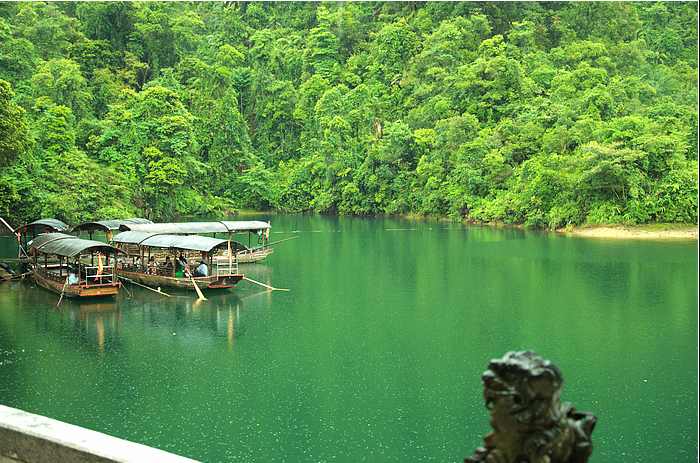
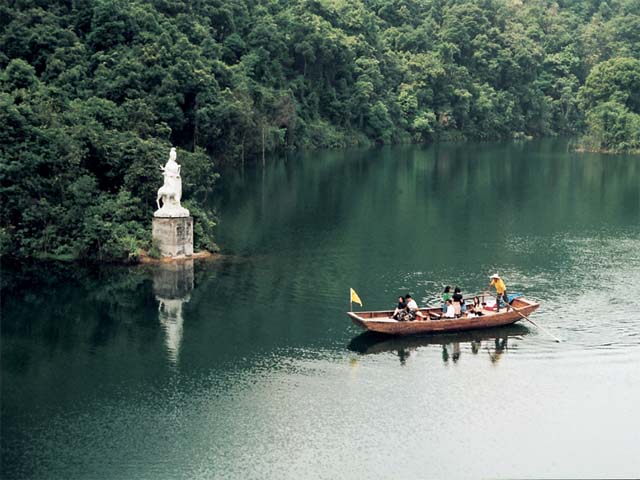
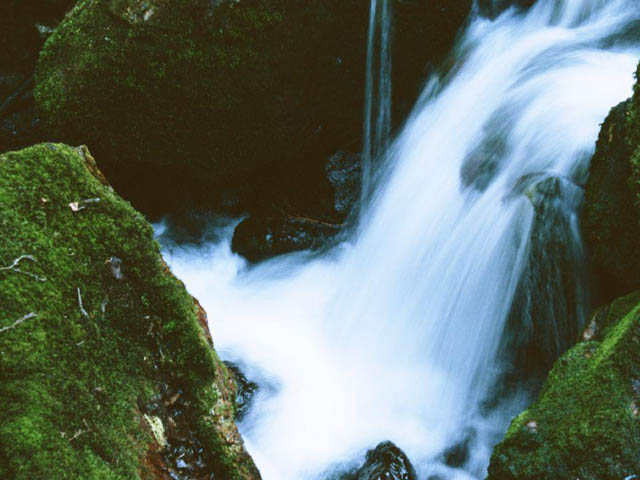
Known as the "green gem on the Tropic of Cancer", the mountain is filled with ancient towering trees, flying waterfalls, fresh air, various birds and colorful flowers. Since ancient times, it has been a tourist attraction and a Buddhist sacred place. Its shrines attract up to 1 million visitors per year.
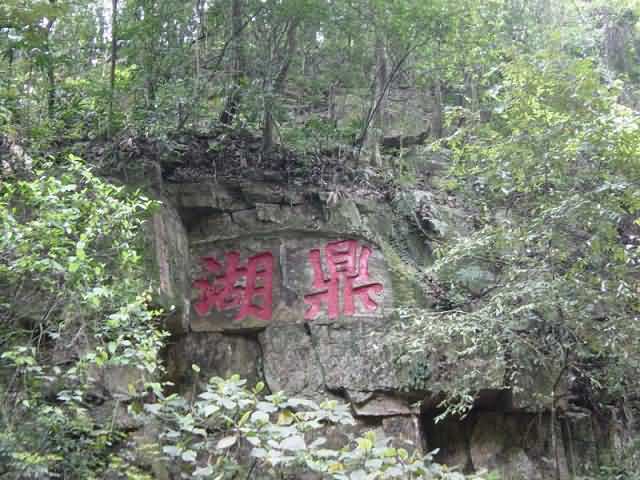
Dinghu Mountain is formed by three scenic areas; they are Tianxi-Qingyun Scenic area, Yunxi-Laoding Scenic area and Tianhu-Dinghu lake scenic area. The major attractions are Baoding Park, Qingyun Temple, and Flying Waterpool.
The transportation from Guangzhou to Dinghu Mountain is convenience. There are direct buses from Guangzhou to Zhaoqing at all bus stations in Guangzhou which can pass Dinghu Mountain on the way.
 |
 |
| the UNESCO "Man and Natural Biosphere" |
green gem on the Tropic of Cancer |
Dinghu Mountain has an area of 113.3 k㎡. Its highest peak, Jilong Mountain, is in the height of 1000.3 meters (3281 ft). Abundant of forest types are distributed here, including montane rainforest, evergreen broad-leaved forest, subtropical evergreen broadleaved forest, coniferous forest and bushes. The best preserved evergreen broadleaved forest is the virgin hypo-forest which has a history of more than 400 years. With abundant plant species, it is home to over 500 species of plants, including 23 rare species in imminent danger under state protection. It is also home to various kinds of animals, including 178 species of birds and 38 species of animals, 15 species of which are under state protection. Famous for its special research value in and abroad, the mountain is regarded as the "Gene warehouse" and "live nature museum" of South China biology species.
Baiyun Mountain has abundant of Natural resources. It is located at the Sub-tropical Climate area so the vegetations on the mountain are enrichment. It has 876 kinds of plants; 5 of them are precious plants protected by the country. Among the 657 wild plants, several of them are in the potential of economic value. The virescence covers 95% area of Baiyun Mountain absorbing 2800 tons of CO2 everyday. Therefore, it is known as "the lung of the city". According to the mensuration, the air quality of Baiyun Mountain has reached the National first standard.
The mountain has also lots of cultural scenery spots. There is a Neolithic relic at Huangpo Cave which is located at the foot of the mountain; the oldest temple here was built in Nan Liang (502A.D-557A.D); Lots of poets wrote poems for the mountain after Tang Dynasty(618A.D~907A.D)and Song Dynasty(960A.D—1279A.D).
 |
 |
| Map of Dinghu Mountain |
The mountain has also lots of cultural scenery spots |
Baoding Park
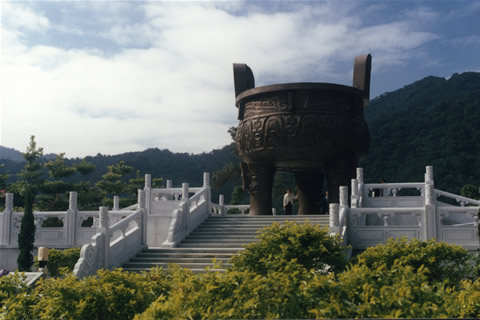
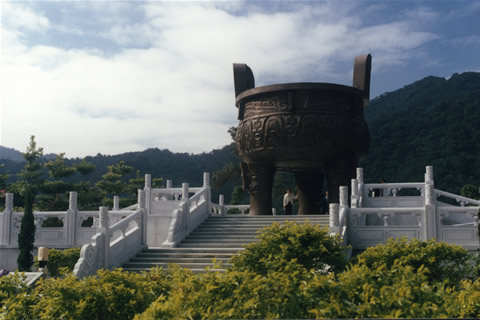
"Ding" is an usually three-legged ancient Chinese cooking which is a representation of ancient Chinese culture. It is a important implement symbolizing comity, unify and peace.
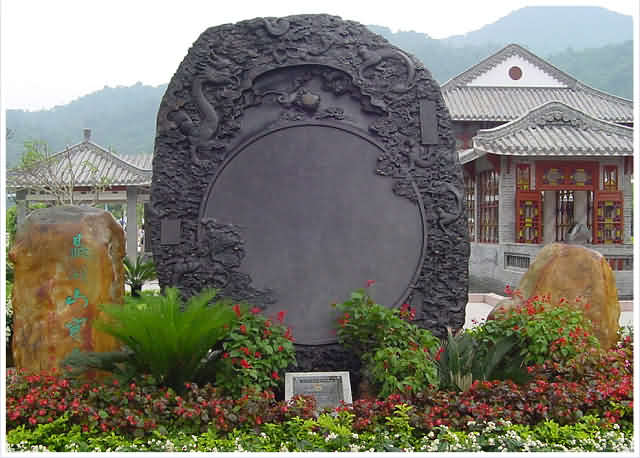
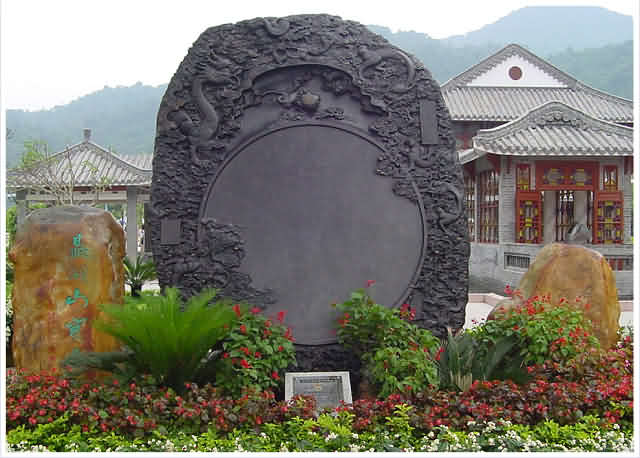
With an area of 13,000㎡, the Baoding Park is located near the Tianhu scenic area of Dinghu Mountain. The theme of the park is to show all kinds of "ancient Ding" to the world. It blends the "ancient Ding" together with the landscapes. Designed by the senior architecture designers and bronze experts in China, the whole park is filled with Chinese culture features. There are two top of the world in the park; one is Jiulong Baoding, the other is Duanxi Dragon Inkstone.
 |
 |
| Jiulong Baoding |
Duanxi Dragon Inkstone |
Qingyun Temple
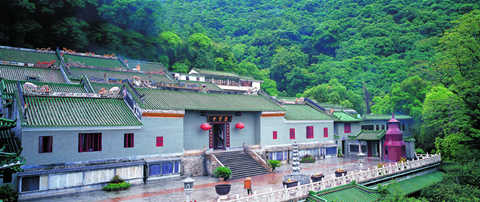
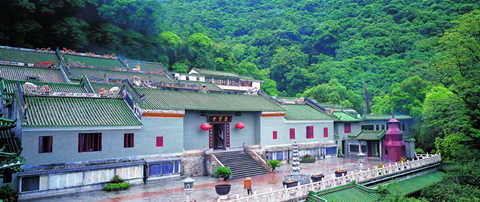
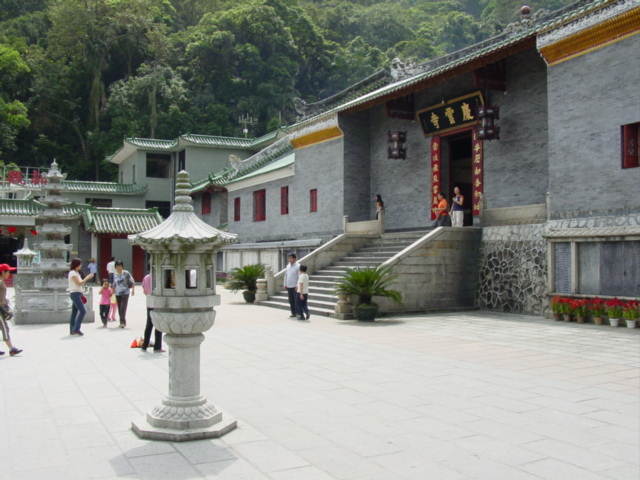
Located in the middle valley of Dinghu Mountain, Qingyun Temple is one of the most famous temples in Guangdong province; the other three are Nanhua temple in Shaoguan, Guangxiao temple in Guangzhou and Kaiyuanzhenguo Temple in Chaozhou. Qingyun temple has strong characteristics of Eastern art and architectures.
In 1633A.D of Ming Dynasty (1368A.D-1644A.D), a monk named Zaiyi came to the mountain and established Lianhua Hut. Qingyun Temple is built on the base of Lianhua Hut. With an area of 12000㎡, the temple has more than 100 halls of different sizes. From the bottom to the top, the first floor is Weituo Hall with drum-tower and bell tower in it; the second floor is the Mahavira Hall; the third floor is Zhongzheng Hall; the fourth floor is Bharhut Hall and the fifth is the Stupa Hall which is the original Lianhua Hut.
The temple has also abundant of cultural relics of Buddhism like Sarira which are the relics of monks after cremation, copper bell and steles.
 |
 |
| one of the most famous temples in Guangdong province |
Qingyun temple has strong characteristics of Eastern art and architectures |
Flying Waterpool
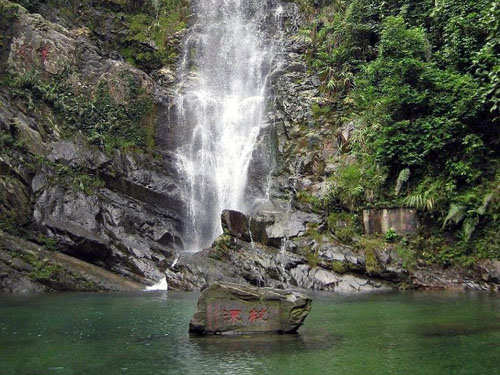
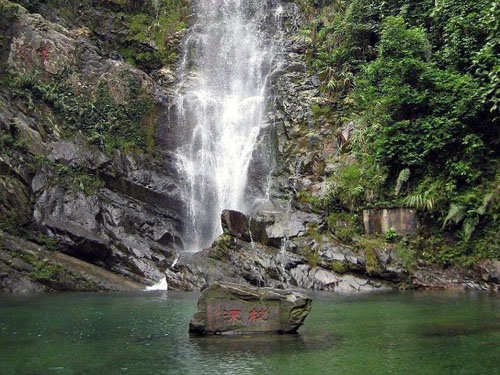
Flying Waterpool is located at the half mountainside of Dinghu Mountain, to the east of Qingyun Temple. A waterfall of more than 40 meters (131.2 ft) rushes down to the pool from the peak of the cliff; the stream below the waterfall forms a lake with a huge stone in the middle.
 |
 |
| The splendid view of Flying Waterpool |
forms a lake with a huge stone in the middle |

- Dinghu Mountain

- The Green Scape

- Green trees and lake

- Map of Dinghu

- Jiulong Baoding

- Duanxi Dragon Inkstone

- Qingyun Temple

- Flying Waterpool